Understanding the language of cinematography is one of the key skills all our students learn in their first year at Escape Studios. Being able to compose an image, take a picture, and use a moving camera is part of the fundamental language of visual storytelling. At Escape Studios, Animators and VFX artists learn how to tell stories with pictures. Watch the video above to see our cinematography class in action, led by Head of VFX Clement Gharini.

Showing posts with label Cinematography. Show all posts
Showing posts with label Cinematography. Show all posts
Thursday, 15 January 2026

Thursday, 7 November 2024
Why Animators Should Cut on Movement

Let's say you are cutting from a wide shot to a close up, you start the motion in the wide shot, then carry it over to the next shot. This makes the cut feel less abrupt.
Wednesday, 30 October 2024
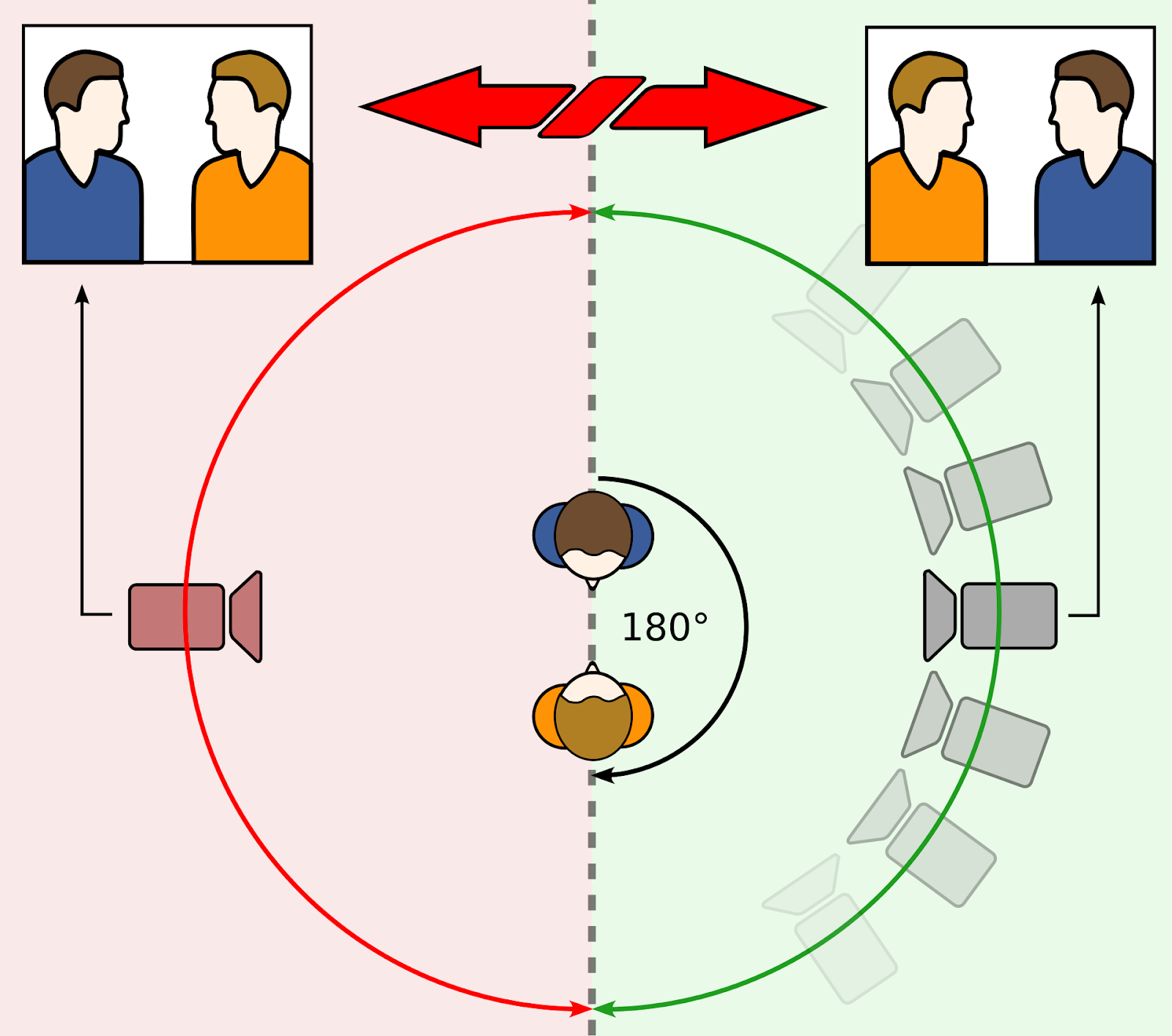
Never Cross the Line: The "180 Degree Rule"
 |
| 180-Degree Rule |
"Crossing the Line" is also known as the "180-Degree Rule", and it is one of the fundamental rules of cinematography.
Like most rules of film-making, the only way to really understand the 180 Degree Rule is to break it, figure out what went wrong - and then work out how to fix it next time.
Let's say you have a shot with two characters talking to one another. Draw an imaginary line between the two characters. This is the "line" that we should not cross.
Friday, 25 October 2024
Why Characters Shouldn't Look at The Camera
 |
| Bugs - stop looking at us! |
Inexperienced animators often make this error. We pose out our character and we think - who is she talking to? I know - she's talking to me! But in a film, or a play, or a TV Series, the camera (ie the audience) is almost always an observer, never a participant.
Part of the so-called Willing Suspension of Disbelief is that the characters acting for us don't know we are there.
Sometimes characters will talk to the camera (like Bugs Bunny, left) but this is unusual. Mostly, on-screen characters look at each other, not at us.
Saturday, 21 September 2024
How to Render Depth of Field in Maya and Arnold
Friday, 30 August 2024
Michael Hunter Returns for Photography Sept 2024
 |
| Michael Hunter teaches Photography and Composition |
One of the first subjects our students will tackle in their first year at Escape Studios, "Photography and Composition ", introduces students to the art and craft of photography, and the compositional skills that underpin the medium.
Wednesday, 1 May 2024
Animate a Simple Camera Shake in Maya
 |
| Animate a Camera Shake in Maya with Monty |
To animate the camera shake is simple - it's just a few keyframes on the x rotation on the shot camera, simulating what might happen to a real camera operator if (as in this example) a school bus were to whizz past at high speed.
Wednesday, 3 April 2024
Understanding the Rule of Thirds
What is the Rule of Thirds? It is a "rule of thumb" for composing visual images. The Rule of Thirds proposes that an image should be imagined as divided into nine equal parts by two equally spaced horizontal lines and two equally spaced vertical lines, and that important compositional elements should be placed along these lines or their intersections. In the simplest terms, try to avoid staging your character dead centre in the middle of the screen.
Thursday, 25 January 2024
How To Create a Shot Camera in Maya
Saturday, 9 December 2023
Sagar Rathod Explains "The Rule of Thirds" - Pt 1
In this short video Escape Studios VFX tutor Sagar Rathod explains the principles behind the "Rule of Thirds" in Previsualisation and Cinematography. The Rule of Thirds - more a guideline than a rule - is a "rule of thumb" for composing visual images such as designs, films, paintings, and photographs. The guideline proposes that an image should be imagined as divided into nine equal parts by two equally spaced horizontal lines and two equally spaced vertical lines, and that important compositional elements should be placed along these lines or their intersections.
Friday, 13 October 2023
"Previs Chess" with Sagar Rathod
In this short video tutorial titled "Pre-Vis Chess", Escape Studios' VFX tutor Sagar Rathod explains how the previsualisation ("previs") process works in vfx film-making. What is previs? What is it for, and how do digital artists use it to solve practical film-making problems? This video forms a part of our growing library of video tutorials on Cinematography, 3D Layout, and Previs, which you can find at our Vimeo Tutorial Channel here.
Wednesday, 4 October 2023
Clement Gharini Explains the Art of Cinematography
Clement Gharini, Escape Studios' Head of VFX, has released the first of a series of tutorials on the Art and Craft of Cinematography for students of VFX, Animation and Games. Clement Gharini worked as a camera operator and compositor for more than 20 years in the film industry before joining us at Escape Studios; he teaches cinematography and compositing, as well as running our Green Screen and Motion Capture pipelines. In this first cinematography episode Clem addresses two simple questions: What is Cinematography? And...Who Needs It?
Monday, 31 July 2023
How to Animate Cameras with Marc Stevenson
In this latest video, Escape Studios' animation tutor Marc Stevenson explains the use of cameras in animation film-making, exploring different kinds of cameras and how to use them. Marc Stevenson has built up a comprehensive library of animation video tutorials, which can be found at his personal YouTube Channel here. Marc’s animation tutorials are all completely free, and can be used at any time by any of our students to catch up on classroom exercises or develop their animation skills.
Sunday, 23 October 2022
Vimeo Tutorials: Camera, Previs & 3D Layout
 |
| The 180 Degree Rule |
We also have a series of tutorials on Cinematography, Camera, Previsualisation & 3D Layout.
All of the above are essentially ways of describing the same problem - how to tell a story visually, with a series of still or moving images.
What is an Establishing Shot? What is "Crossing The Line"? Watch our playlist below to find out.
Saturday, 13 August 2022
Cinematography and Lighting with Clem Gharini
Cinematography and Lighting starts again on September 19th; one of a number of mini-modules taken by all our first year students. Taught by our in-house Director of Photography Clement Gharini, Cinematography and Lighting module introduces students to the art of moving cameras and green screen photography. Cinematography is one of the core skills that all our students must master; to find out more, watch the video above, and read Clem's post below.
Tuesday, 5 July 2022
Meet Your Tutors - Clement Gharini
 |
| Clement Gharini |
Clement teaches CR4001 Craft Foundations - Cinematography in which our undergraduate students first get to grips with live action cameras, offering a foundation for the study of cinematography.
Monday, 17 January 2022
"Planet Mars" Best Cinematography at GNIFF
 |
| Planet Mars Best Cinematography at Golden Nugget Fest |
Directed by Escapee Sebastian Kuder, and produced by Katerina Zacharakis, Planet Mars was a Studio Project completed by second year animation students at Escape Studios. It has won many festival awards.
Friday, 23 April 2021
Cinematography in Unreal Engine with Clem
 |
| Clement Gharini |
As Unreal Engine becomes an increasingly important visualisation tool, not just in Games but in Animation & VFX, Clem is introducing our students to the use of cameras in Unreal Engine, demonstrating how to integrate different tools across multiple platforms.
Wednesday, 17 March 2021
"Good Old Days" Wins Best Cinematography
 |
| "Good Old Days" wins "Best Cinematography" |
The Good Old Days is a story about an elderly gentleman who tries to re-live the glory days of his youth, but things don't quite go to plan.
Sunday, 14 February 2021
Why Animators Must View Shots in Continuity
 |
| Jerich0 - excellent shot continuity |
Animators are commonly assigned to work on single shots on a project, which means there will be another shot, animated by another animator, on either side of theirs.
These shots must play together in continuity, meaning that there must be a smooth flow from one to another. The character's pose at the end of Shot 1 should be the same pose in Shot 2, or else the shots won't "hook up".
Subscribe to:
Posts (Atom)